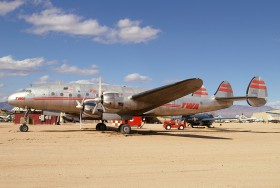
After the commercial success of the L-049 Constellation, Lockheed produced a slightly improved version designated L-749. This aircraft attracted the attention of the U.S. Air Force, which bought ten of them for long-range VIP transports and designated them VC-121A. The new transports proved to be very popular and regularly carried high-ranking Generals and Presidents.
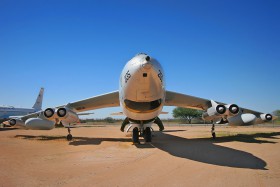
The U.S. Army Air Forces issued its first requirement for a jet bomber in 1943. However, it was not until after the war, when German research on high-speed aircraft became available that the design of the B-47 was finalized. The B-47 became the first all jet bomber produced anywhere in the world. Over two thousand Stratojets were built between 1947 and 1957.
The B-36 is the largest bomber and the last piston engine powered bomber produced by the United States. First designed to meet a World War II requirement for a plane capable of hitting targets in Germany from bases in the United States the prototype did not fly until August 8, 1946.
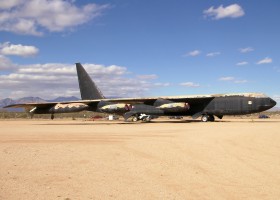
The B-52 "A" built only 3 pieces. None of the B-52As ever entered operational service with the USAF. 52-0003 was modified to NB-52A standard and used as a "mother ship" for the X-15.
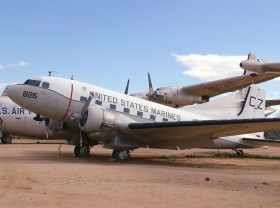
These specialised aircraft were responsible for the sometimes hazardous Volant DEW resupply mission to DEW-Line radar stations on the Alaska, Canada and Greenland ice cap.
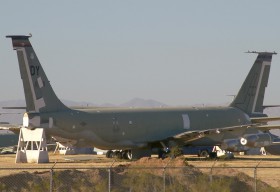
This KC-135A have interested history. Manufactured in 1957, used in experiments to determine effects of Aurora Borealis on radio communications in 1957/58, later used in nuclear weapon test programs, wfu to AMARC 28.04.1993 after TT 14062 hours.